ViQure vs DermRays: Which At-Home Laser Hair Removal Device Is Better?
ViQure and DermRays both use more targeted light technology than standard IPL devices, but their models work at different wavelengths and don’t all use the same type of light source.
The ViQure S-LD uses a 780–850 nm range, while the ViQure EpiPro uses 808 nm. DermRays offers the V6S at 1064 nm and the V8S at 810 nm.
This comparison looks at how the devices differ across a full course of at-home laser hair removal. I looked at how much energy they deliver, how much skin they cover per flash, which skin tones they’re designed for, and how their cooling and treatment schedules may affect session time and frequency.
Not sure which model suits your skin tone and treatment area? Jump to the ViQure vs DermRays device finder quiz
ViQure vs DermRays Quick Verdict
ViQure lists higher maximum fluence figures and spaces its sessions farther apart, while both DermRays models use a wider 3 cm² treatment window. The DermRays V6S also adds a 1064 nm option for Fitzpatrick skin types I–VI.
Choose ViQure if you want precise placement around the face, underarms, or bikini line. The S-LD has a compact treatment window, while the larger EpiPro suits broader areas.
Choose DermRays if you want to cover the legs or torso with fewer placements. The V6S is the model to examine for Fitzpatrick VI skin, while the V8S has a higher stated maximum fluence than the V6S and is marketed for Fitzpatrick skin types I–V.
Get professional guidance first if you have Fitzpatrick VI skin, previous hyperpigmentation, recently tanned skin, or facial hair linked to a hormonal condition.
Disclosure: This article contains affiliate links. As an Amazon Associate I earn from qualifying purchases at no extra cost to you. Read more.
ViQure vs DermRays: Side-by-Side Comparison
| Device | Light Source and Wavelength | Maximum Stated Fluence | Treatment Area | Skin-Tone Guidance | Brand Treatment Schedule | Shop |
|---|---|---|---|---|---|---|
| ViQure S-LD | Diode LED, 780–850 nm | 25 J/cm² | 8 × 8 mm (0.64 cm²) | Fitzpatrick I–V | Every 4–6 weeks for 3–5 treatments | Shop Now |
| ViQure EpiPro | Diode laser, 808 nm | 30 J/cm² | 12 × 14 mm (1.68 cm²) | Marketed for Fitzpatrick I–VI | About every 28 days for 3–6 cycles | Shop Now |
| DermRays V6S | Diode laser, 1064 nm | 7 J/cm² (21 J across 3 cm²) | 30 × 10 mm (3 cm²) | FDA filing states Fitzpatrick I–VI, including tanned skin | 3 times weekly for 2 weeks, twice weekly for 2–3 weeks, then monthly | Shop Now |
| DermRays V8S | Diode laser, 810 nm | 9 J/cm² (27 J across 3 cm²) | 30 × 10 mm (3 cm²) | Brand lists Fitzpatrick I–V | 3 times weekly for 2 weeks, twice weekly for 2–3 weeks, then monthly | Shop Now |
ViQure vs DermRays: LED and Diode Laser Technology
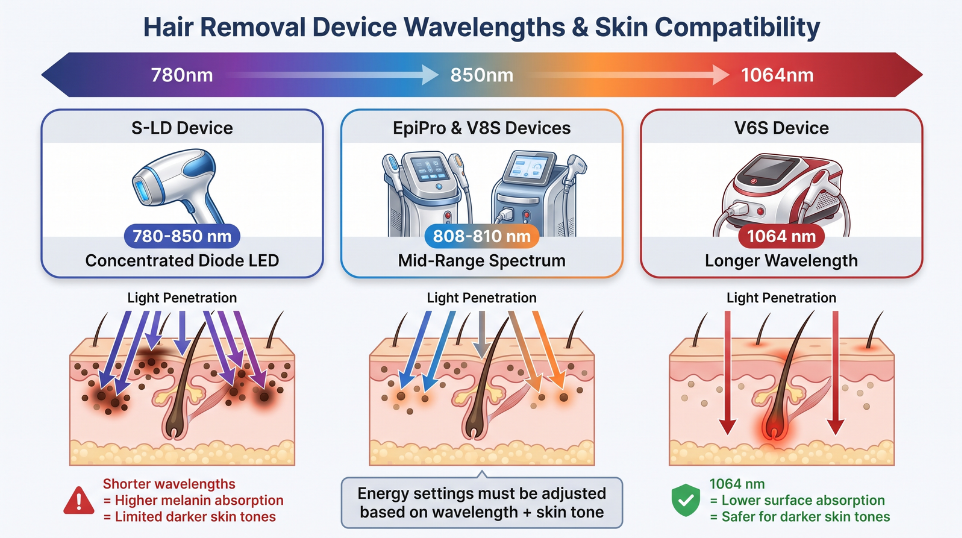
ViQure and DermRays use different wavelengths, which changes how the light interacts with melanin in the hair and skin.
- The ViQure S-LD uses a concentrated 780–850 nm diode LED
- The ViQure EpiPro uses an 808 nm diode laser
- The DermRays V8S uses 810 nm.
These wavelengths are absorbed strongly by melanin, so they are best suited to dark hair and require more care as skin tone deepens.
The DermRays V6S uses a 1064 nm wavelength, which is absorbed less strongly by skin melanin than 808–810 nm light. Its FDA indication covers Fitzpatrick skin types I–VI, including tanned skin, making it the DermRays model designed to cover the broadest range of skin tones.
Professional clinics often use long-pulsed 1064 nm Nd:YAG lasers for darker skin tones. Although the V6S uses the same wavelength, it shouldn’t be called an Nd laser. Its FDA summary identifies it only as a solid-state laser.
By comparison, the ViQure S-LD is notable for its higher stated fluence. It delivers 9.5 to 25 J/cm² across an 8 × 8 mm treatment window, with pulse durations from 108 to 320 milliseconds.
Even so, a higher fluence figure does not automatically mean better hair reduction because wavelength, pulse duration, cooling, and skin tolerance also shape the treatment.
Hair color is another limit across all four devices. Dark hair contains more melanin for the light to target, while blond, red, gray, and white hair contain less pigment and usually respond less reliably to at-home light-based hair removal.
My guide to dermaplaning at home for beginners explains how to temporarily remove fine facial hair that lacks enough pigment for these devices.
ViQure vs DermRays: Laser Hair Removal Fluence, Joules and Treatment Window Size
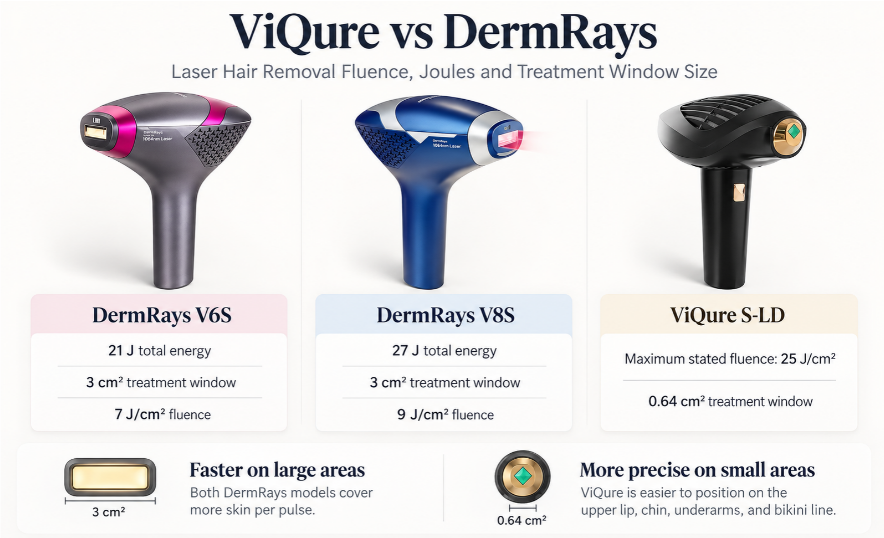
Fluence tells you how much energy each pulse delivers to the skin. Treatment-window size tells you how much area that pulse covers. Together, they shape how strong treatment can be and how long each session may take.
The DermRays V6S delivers 21 J across a 3 cm² window, equal to 7 J/cm². The V8S delivers 27 J across the same area, or 9 J/cm². The ViQure S-LD reaches a higher stated maximum of 25 J/cm².
That does not mean the S-LD will remove hair faster. Fluence is only part of the picture. The wavelength and pulse duration also affect how the follicle is heated. Cooling and your skin’s tolerance can limit how high you can safely set the device.
The difference you are more likely to notice during a session is the treatment window. Both DermRays models cover 3 cm² per pulse, while the ViQure S-LD covers 0.64 cm².
That wider DermRays window can make a big difference on the legs or torso because you need fewer placements to cover the same area.
The S-LD takes longer on large areas, but its smaller spot is easier to position around the upper lip or chin. It also gives you more control around the underarms and bikini line.
The 3 cm² DermRays window requires fewer placements than either ViQure model when treating the legs or torso. Actual session time will also depend on pulse speed and how quickly you reposition the device. The smaller S-LD window gives you more control around the upper lip, chin, underarms, and bikini line.
Check the current ViQure S-LD offer if you’re focusing on smaller areas, or compare DermRays models if you want a wider window for the legs or torso.
Best At-Home Laser Hair Removal for Dark Skin
For darker skin, wavelength is one of the first things to check. More melanin in the skin means more light can be absorbed near the surface, so the wrong wavelength or an overly high setting can increase the risk of excess heat and pigment changes.
Professional clinics often use long-pulsed 1064 nm Nd lasers for skin of color because the skin’s surface absorbs less energy at 1064 nm than at shorter wavelengths. The DermRays V6S uses the same wavelength, and its FDA indication includes Fitzpatrick skin types I–VI.
The V6S delivers 5 to 7 J/cm² with a 350–450 millisecond pulse width. It is not the same as a professional Nd:YAG system, which gives a clinician more control over treatment settings and lets them monitor the skin throughout the session. That level of supervision may be preferable for anyone with a history of burns, persistent hyperpigmentation, or highly reactive skin.
The ViQure EpiPro and DermRays V8S operate at 808–810 nm. Melanin absorbs more strongly at these wavelengths than at 1064 nm, which can work well on dark hair but calls for more conservative settings on deeper skin tones.
For darker skin, the safest place to start is the setting recommended for your skin tone in the manual. Complete a patch test first and wait for any delayed reaction before treating a larger area.
| Skin and Hair Profile | Device to Consider First | Why It May Suit You | Check Before Treatment |
|---|---|---|---|
| Fitzpatrick I–III with dark hair | ViQure S-LD, EpiPro, or DermRays V8S | Choose between the S-LD’s compact treatment spot and the larger windows on EpiPro and V8S | Confirm that your hair contains enough dark pigment for light-based treatment |
| Fitzpatrick IV–V with dark, coarse hair | ViQure S-LD or DermRays V6S | The S-LD offers higher stated fluence, while the V6S uses a longer 1064 nm wavelength | Begin at the lowest setting recommended for your skin tone and patch test first |
| Fitzpatrick VI with dark hair | DermRays V6S or professional 1064 nm treatment | The V6S FDA indication includes Fitzpatrick VI, while a clinic can tailor treatment as your skin responds | Check the V6S purchasing requirements where you live and follow its skin-tone guidance |
| Dense or hormonally influenced facial hair | Professional assessment before purchasing | Conditions such as PCOS can continue stimulating new hair growth after existing hair is treated | Treatment for the underlying hormonal cause may be needed alongside hair reduction |
If you have Fitzpatrick VI skin, a history of hyperpigmentation, recent sun exposure, or take medications that affect light sensitivity, professional guidance is a safer starting point before using an at-home laser device.
Hormonal facial hair also deserves a different approach. Laser can reduce existing dark hair, but it does not stop the hormonal process that may continue producing new growth.
Still unsure which wavelength suits your skin tone? Take the four-question device finder to compare the ViQure and DermRays models based on your skin, hair, treatment area, and preferred schedule.
ViQure vs DermRays: Cooling, Pain Levels and Full-Body Laser Hair Removal Treatment Time
Cooling can make at-home laser hair removal easier to tolerate, especially on coarse hair or sensitive areas. It lowers the skin surface temperature during each pulse, which may make higher settings more comfortable.
ViQure states that the S-LD treatment surface stays between 32°F and 50°F during use. That chilled contact surface can soften the heat you feel as you move across areas with coarse or dense hair.
The ViQure EpiPro uses thermoelectric cooling and includes coupling and cooling gel. The gel adds some preparation and cleanup, but the 12 × 14 mm treatment window covers the legs and other larger areas faster than the smaller S-LD head.
The DermRays V6S and DermRays V8S have built-in contact cooling and a 30 × 10 mm treatment window. The larger window requires fewer placements across the legs, arms, chest, and torso, which can shorten full-body treatment sessions.
These devices aren’t necessarily painless. Coarse hair and areas with denser growth can still cause a sharp heat or snapping sensation, especially at higher power levels.
Follow the manual’s patch-test instructions whenever you increase the energy level. Stop treatment and seek medical advice if you develop persistent pain, blistering, or a noticeable change in skin color.
ViQure vs DermRays Treatment Schedule: How Often to Use Each Laser
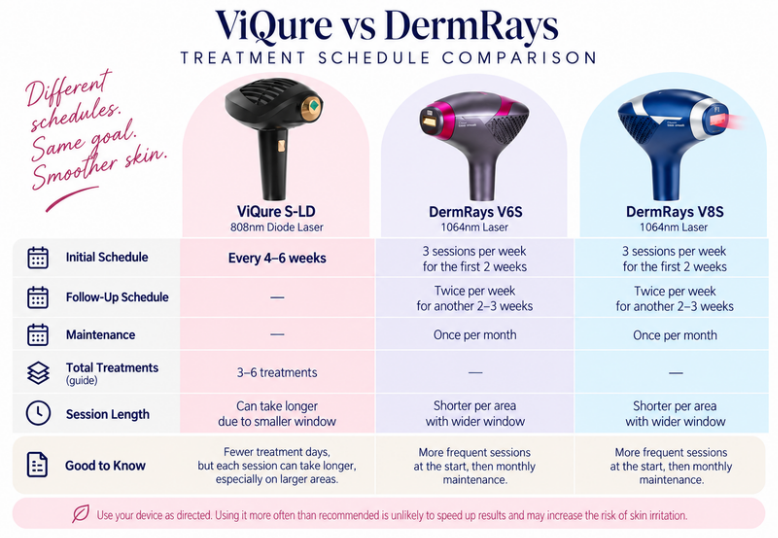
The treatment schedule is one of the main differences between ViQure and DermRays. ViQure spaces treatments several weeks apart, while DermRays starts with multiple sessions each week before switching to maintenance.
ViQure keeps the treatment schedule relatively light. Current S-LD guidance spaces sessions about four to six weeks apart, with three to five treatments suggested. EpiPro follows a 28-day cycle, with ViQure estimating three to six cycles depending on the hair and treatment area.
The trade-off is session length. A full-body treatment can take longer with the S-LD’s smaller window, but you only need to set aside one treatment day every few weeks rather than several sessions each week.
DermRays V6S and V8S take a more frequent approach. The recommended introductory schedule is three sessions per week for the first two weeks, followed by twice-weekly treatments for another two to three weeks. After that, treatment moves to monthly maintenance.
So the trade-off is straightforward. ViQure asks for fewer treatment days, while DermRays requires more frequent sessions at the start but covers more skin with each pulse thanks to its wider treatment window.
Using the device more often than the manual recommends is unlikely to speed things up and may increase skin irritation. Hair follicles cycle through different growth stages, so stick to the schedule for your exact model even if some regrowth appears between sessions.
If spacing treatments four to six weeks apart works better for your schedule, see the current ViQure options.
DermRays calls for more frequent sessions at the start, but its devices have a wider treatment window. If that suits how you plan to treat larger areas, you can compare the V6S and V8S here.
Find the Right ViQure or DermRays Device for You
Find the Right At-Home Laser Hair Removal Device
Answer four quick questions to compare ViQure and DermRays devices for your skin tone, hair color, treatment area, and preferred schedule.
The finder compares the ViQure S-LD, ViQure EpiPro, DermRays V6S, and DermRays V8S.
ViQure vs DermRays: Which At-Home Hair Removal Device Should You Buy?
In short, the right device depends on how you plan to treat your hair and which wavelength suits your skin tone.
ViQure spaces sessions about a month apart and gives you two treatment-window sizes. The compact S-LD is easier to position around the upper lip, chin, underarms, and bikini line, while the EpiPro’s 12 × 14 mm window moves faster across larger areas.
DermRays gives both models a wider 3 cm² treatment window, so the legs and torso need fewer placements. The V6S uses 1064 nm and has an FDA indication covering Fitzpatrick skin types I–VI. The V8S uses 810 nm, covers Fitzpatrick I–V, and is cleared for over-the-counter sale in the United States.
If you prefer longer gaps between sessions and a choice between smaller-area control and broader coverage, ViQure is the stronger option. If you want a larger treatment window or specifically need a 1064 nm at-home laser, DermRays offers those features.
For smaller treatment areas and monthly sessions, see current ViQure S-LD and EpiPro options.
For a wider treatment window or a 1064 nm model, compare DermRays hair removal devices.
Frequently Asked Questions
Is The ViQure S-LD A Real Laser?
No. The FDA summary describes the ViQure S-LD as a diode LED device that emits 780–850 nm near-infrared light. ViQure EpiPro and the DermRays models use diode lasers.
Is DermRays V6S Or V8S Better For Dark Skin?
The DermRays V6S is better suited to darker skin tones because its 1064 nm wavelength is absorbed less strongly by skin pigment. Its FDA filing covers Fitzpatrick I–VI, while DermRays lists the 810 nm V8S for Fitzpatrick I–V.
Does 25 J/cm² Mean ViQure Works Better Than DermRays?
No. The ViQure S-LD has a higher stated fluence, but fluence alone doesn’t determine hair-reduction results. Wavelength, pulse duration, cooling, hair color, skin tone, and the setting used also affect treatment.
Can ViQure or DermRays Permanently Remove Hair?
DermRays V6S and V8S are cleared for permanent hair reduction, which describes a lasting decrease in regrowth rather than every hair disappearing forever. ViQure markets the S-LD and EpiPro for long-term hair reduction.
Some hair may remain, while hormonal changes and new growth cycles can lead to regrowth over time. Occasional maintenance sessions may still be needed after the initial course.
Which Device Is Faster For Legs Or Full-Body Hair Removal?
DermRays is likely faster than the ViQure S-LD for large areas because its 3 cm² treatment window requires fewer placements than the S-LD’s 0.64 cm² window. ViQure EpiPro also uses a larger handpiece.
Can These Devices Treat PCOS Facial Hair?
Yes, dark facial hair associated with PCOS may respond to light-based hair reduction. However, these devices don’t treat the underlying hormonal condition, so new hair can continue to grow and maintenance sessions may be needed.
